Anahata - The Heart Beyond the Heart
Published: Thu Sep 17 2026
In the language of Yoga, the heart is not understood only as a physical organ.
There is a distinction between the physical heart and what the tradition describes as the subtle heart-centre. The physical heart belongs to the visible body and its physiological functions. Anahata belongs to the language of the subtle body, praṇa, inner experience and consciousness.
Understanding this distinction helps us approach Anahata without reducing it either to anatomy or to a purely abstract spiritual idea.
Anahata - The Heart Centre
In many Yoga and Tantric traditions, Anahata Chakra is described in the region of the centre of the chest and is traditionally regarded as the fourth of the seven principal chakras.
The word Anahata carries the meaning of the “unstruck sound” — a sound that is not produced through the collision of two external objects. It points towards a subtle inner experience described in the yogic tradition.
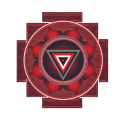
Traditionally, Anahata is associated with the element of air (Vayu), a lotus of twelve petals, the seed mantra YAM, and qualities such as love, compassion, balance and devotion.
These are traditional descriptions of the subtle body. They should not be confused with anatomical structures that can be identified through modern medicine.
The Heart and Praṇa
The physical heart has a central role in circulation.
In Yoga, however, the chest region is also regarded as an important field of praṇic activity. Praṇa Vayu is traditionally associated with the region of the chest and the movement of breath, while Vyana Vayu is described as extending throughout the body.
From the traditional perspective, one can therefore contemplate a relationship between:
Breath → Praṇa → Heart Centre → Expansion throughout the body
This is a yogic way of describing experience and function. It is not a physiological model of blood circulation.
The distinction is important: traditional yogic language and modern physiology describe the human being through different frameworks.
Anahata - A Meeting Place
When the traditional sequence of the chakras is considered,
Muladhara → Svadishtana → Maṇipiraka → Anahata → Visuddhi → Ajna → Sahasrara
Anahata occupies a central position.
The lower centres are traditionally associated with aspects of embodied existence, vitality, instinct and action, while the higher centres are associated with expression, awareness and subtler dimensions of experience.
Anahata therefore has often been understood as a bridge - a meeting place between the embodied and the subtle, between personal feeling and a wider sense of compassion and connection.
This is one reason why the language of the “open heart” appears so frequently within Yoga and devotional traditions.
Breath, Heart and Mind
There is also an interesting meeting point between traditional practice and modern physiology.
When a person experiences stress, breathing patterns and heart rate can change. Conversely, slow and controlled breathing can influence autonomic regulation and may affect heart-rate patterns and parasympathetic activity.
This gives us a physiological perspective on why practices involving breath and attention may influence one's experience of calmness.
But this does not establish the physical existence of chakras as anatomical organs.
The traditional understanding of Anahata remains a subtle and experiential framework.
Anahata and the Inner Experience
The heart has always carried a deeper meaning in Yoga and spiritual traditions.
Anāhata is traditionally associated with:
Love · Compassion · Forgiveness · Devotion · Equanimity · Kindness · Inner connection
Therefore expressions such as “opening the heart,” “purifying the heart,” or “meditating in the heart” should not be understood as referring simply to the cardiac muscle.
Here, the word heart also points towards an inner centre of human experience.
It is a language of consciousness.
The Nadis at Anahata
In the traditional Haṭha Yoga and Tantric descriptions, three principal nadis are frequently spoken of:
Iḍa· Pingala · Susumna
Traditional yogic imagery describes these subtle pathways in relation to the chakra system, with Anahata regarded as one of the important centres within this network of praṇic experience.
The word nadi, however, should not simply be translated as the modern anatomical term nerve.
A nadiī belongs to the traditional subtle-body framework and does not correspond precisely to a structure identified in modern anatomy.
The Anahata Nada
One of the most beautiful ideas associated with Anahata is Anahata Nada - the inner or “unstruck” sound.
In deeper states of meditation, the practitioner may turn away from external sensory activity and become increasingly attentive to subtle inner experience.
The tradition describes this inward movement through the language of Anahata Nada.
It is not simply about hearing an external sound. It points towards a subtler dimension of awareness described through the yogic experience of inner sound.
The Heart Beyond the Physical Heart
The physical heart and Anahata should neither be completely separated nor simply declared to be the same thing.
The physical heart belongs to the sthula sarira, the visible and physiological body.
Anahata belongs to the traditional understanding of the sukṣma sarira, the subtle body.
Their relationship is therefore best approached through the language of prana, awareness, experience and symbolism, rather than by trying to turn one into the other.
In simple words:
The physical heart is a centre of circulation in the body. Anahata is the yogic heart-centre associated with praṇa, love, compassion, inner awareness and the experience of the unstruck sound.
To understand Anahata is therefore not merely to locate a point on the body.
It is to understand why, in the ancient traditions, the heart became a doorway between the body, breath, mind and deeper awareness.