
Psychospiritual Causes of Human Suffering
Published: Sat Jun 13 2026
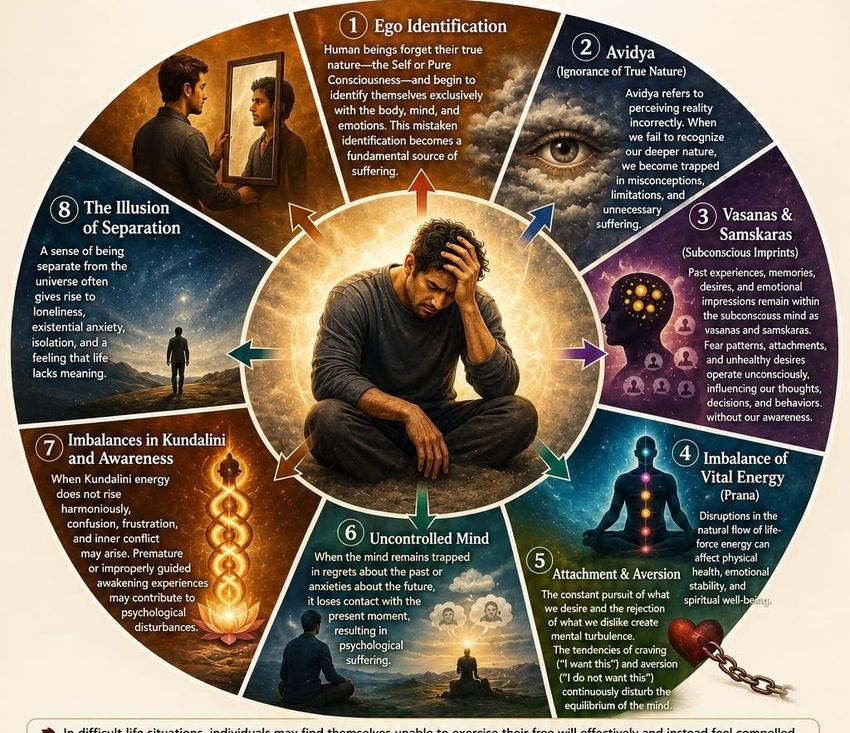
Human suffering cannot be understood solely through physical, psychological, or social perspectives. Many spiritual traditions including Tantra, Vedanta, and Buddhism suggest that suffering also has a profound psychospiritual dimension.
At first glance, many physical illnesses, psychological disorders, and life difficulties appear to arise from adverse life circumstances, irrational fears, a lack of inner security, difficulty loving and accepting oneself, and a lack of self-confidence.
From a psychospiritual perspective, however, these conditions may be rooted in karmic influences, weakened energy within the Muladhara (Root) Chakra, imbalances in the flow of Kundalini energy, and disharmony among the chakras.
These causes can be understood through several key factors:
Ego Identification
Human beings often forget their true nature the Self or Pure Consciousness and begin to identify themselves exclusively with the body, mind, and emotions. This mistaken identification becomes a fundamental source of suffering.
Avidya (Ignorance of One's True Nature)
Avidya refers to perceiving reality incorrectly. When we fail to recognize our deeper nature, we become trapped in misconceptions, limitations, and unnecessary suffering.
Vasanas and Samskaras (Subconscious Imprints)
Past experiences, memories, desires, and emotional impressions remain within the subconscious mind as vasanas and samskaras.
Fear patterns, attachments, and unhealthy desires often operate unconsciously, influencing our thoughts, decisions, and behaviors without our awareness.
Imbalance of Vital Energy (Prana)
Disruptions in the natural flow of life-force energy can affect physical health, emotional stability, and spiritual well-being.
Attachment and Aversion
The constant pursuit of what we desire and the rejection of what we dislike create mental turbulence.
The tendencies of craving ("I want this") and aversion ("I do not want this") continuously disturb the equilibrium of the mind.
The Uncontrolled Nature of the Mind
When the mind remains trapped in regrets about the past or anxieties about the future, it loses contact with the present moment, resulting in psychological suffering.
Imbalance in Kundalini and Awareness
When Kundalini energy does not rise harmoniously, confusion, frustration, and inner conflict may arise.
Likewise, premature or improperly guided awakening experiences may contribute to psychological disturbances.
The Illusion of Separation
A sense of being separate from the universe often gives rise to loneliness, existential anxiety, isolation, and a feeling that life lacks meaning.
In difficult life situations, individuals may find themselves unable to exercise their free will effectively and instead feel compelled to act mechanically according to deeply ingrained patterns and karmic tendencies. This can become a significant source of suffering.
Another major obstacle to personal growth is the inability to evaluate oneself objectively. Genuine progress requires recognizing one's strengths, weaknesses, limitations, shortcomings, and potentials, and accepting oneself completely with both virtues and imperfections.
When a person develops this level of self-acceptance, there is less need to blame external circumstances or other people for personal failures. As a result, unnecessary hatred, resentment, jealousy, envy, and hostility naturally diminish.
Many illnesses are believed to be linked to psychological states that influence hormonal balance and the body's biochemical processes.
Changes in the vibrational state of the chakras, dysfunctions in the corresponding glandular systems, hormonal imbalances, and reduced efficiency of the nervous system, brain, and other physiological functions can contribute to disease and make life increasingly difficult.
Approaches to Healing and Transformation
A balanced diet, appropriate physical exercise, adequate rest, quality sleep, conscious breathing practices, and Anuloma Viloma Pranayama can help strengthen vital energy, harmonize the left and right hemispheres of the brain, and regulate the body's internal chemistry.
Practices such as chanting the bija mantras associated with the six primary chakras and performing specific mudras are traditionally believed to help energize and balance these centers.
Regular positive self-suggestion, mantra japa, and meditation can assist in cultivating objectivity, increasing vital energy, identifying personal limitations, reducing negative tendencies, and strengthening self-confidence, inner security, and loving awareness.
These practices can contribute significantly to a happier, healthier, and more balanced life.
The Highest Path
Many spiritual traditions teach that the most profound approach to understanding, transcending, and ultimately resolving human suffering is the study and practice of Para Vidya or Brahma Vidya the knowledge of the Absolute Reality and the true nature of the Self.